
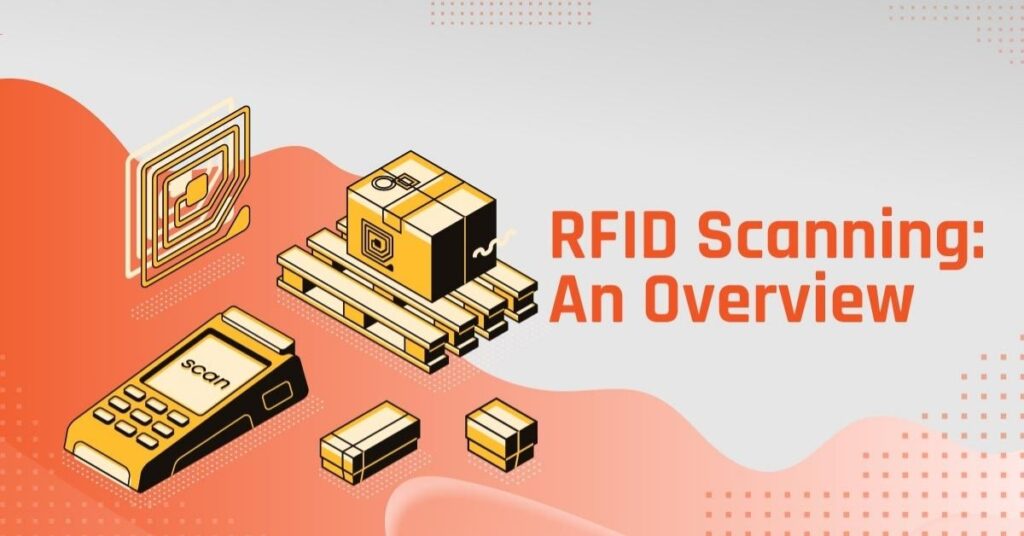
RFID stands for Radio Frequency Identification which uses radio frequency waves to transfer data wirelessly and without contact. Functionally, barcodes are different from RFID scanners because the scanner needs a line of sight to the barcodes. RFID tags & scanners do not need a line of sight—they communicate with the RFID tags on items without needing to see them individually.
An RFID tag ensures a manufacturer can track every single part it uses in its goods, providing visibility over every moving part in the supply chain.
One of the fastest-growing technologies in today’s warehouse is radio frequency identification (RFID). Increases in RFID adoption as well as advances in related technology have made it a much more affordable and cost-effective option for warehouses looking to better automate their inventory management and workflows.

What is an RFID Scanner?

- RFID stands for “radio frequency identification”
- At a simple level, RFID systems consist of three components: an RFID tag or smart label, an RFID reader, and an antenna
- RFID tags contain an integrated circuit and an antenna, which is used to transmit data to the RFID reader (also called an interrogator)
- The reader then converts the radio waves to a more usable form of data
- Information collected from the tags is transferred through a communications interface to a host computer system, where the data can be stored in a database and analyzed later
How does it work?
- RFID scanning belongs to a group of technologies referred to as Automatic Identification and Data Capture (AIDC)
- AIDC methods automatically identify objects, collect data about them, and enter those data directly into computer systems with little or no human intervention
- RFID tags and scanners methods utilize radio waves or Bluetooth low energy systems to accomplish this
- When an RFID tag attaches to an item, a special scanner is deployed that can read stored data revealing inventory status and location within the Supply Chain.
- Warehoused items labeled with an RFID tag contain referential data on an internal memory chip
- The disposition of the chip is adjustable as it progresses through the supply chain
- RFID tags automatically detect the wireless reader from a distance allowing inventory to be continuously updated as it enters and departs the warehouse facility

What is the difference between RFID Scanners & Barcode Scanners?
The key difference between RFID scanners and barcode technology is that RFID scanners do not require line of sight to read tags. This means that RFID scanners can read tags from a distance, even if they are hidden or obscured. Barcode scanners, on the other hand, require direct line of sight to read barcodes.
Advantages of RFID
Superior to barcodes
RFID tags are foremost preferred over barcodes because the chips are not subject to failure in scans or human error and the tags do not require the reader to be in the same line of sight. Resource-intensive manual scanning processes are eliminated with RFID & the inventory is scan-able and traceable, even as these materials rest, out of view, beneath other items.
Enhances warehouse efficiency
RFID helps in automating and streamlining scanning processes that used to be manual. All materials labeled with an RFID tag transmit wireless data communication to the warehouse software and central database. The RFID-tagged items automatically track and update arrival and departure events, with just about anything in between.
Reduced human errors
RFID essentially eliminates the potential for human error because information transfers remotely and automatically, warehouse items are less prone to fall through the cracks. There are no missed scans attributable to human error or barcode reader malfunctions.
Better inventory control and accuracy
By being able to capture inventory data and locations automatically and accurately, RFID can know exactly what products or materials are in stock and how many are needed to maintain and replenish.
Flexibility & durability
RFID tags are generally placed as stickers, which can be applied or removed from any object either wood, plastic or metal and offer the freedom to be placed on any point since these tags do not necessarily have to come in direct contact with the scanner and can be easily detected from a distance. RFID tags are quite durable, encrypt able, non-vulnerable to harsh weather conditions or tampering.
Disadvantages of RFID
Scanning single vs multiple items
If a pallet contains multiple boxes of different shapes and sizes, capturing data needs to happen at all angles to ensure every item is scanned.
To use RFID effectively in a warehouse or loading dock environment, RFID blocks are used to form barriers between the readers, so that the same items are not scanned multiple times.
Material limitations
RFID tags and labels are very specific to the type of material and size of the assets. For example, metal will deactivate the RFID antenna and the tag will not transmit at all. Liquid products can also affect the reliability of the signal.
Cost Comparison
A typical barcode label costs a few cents each, while an RFID tag can run from one dollar upwards of 30 dollars depending on the type of tag. RFID readers are also about ten times more expensive than barcode scanners. In addition to the cost of the tags and readers, RFID implementation is significantly more expensive and complex than a barcode.
Types of RFID
Low Frequency
Operating under 134.2 KHz, the low frequency range requires the tag to be in close contact with an RFID reader in order to transmit data.
High Frequency
Operating around 13.56 MHz, HF RFID tags have a read range of approximately one to three feet at the most
Ultra High Frequency
Operating between 800-900 MHz and higher, UHF RFID is typically used in large warehouses and distribution centers that need to track and identify multiple items at once
Applications of RFID
Low Frequency
- Using RFID tags on cows’ ears offers a durable way to track the animal over a period of time
- In the event of contamination, grocery stores can determine exactly which batch of meat needs to be recalled and even which animal it came from
- These tags work best because are more durable than a barcode
- Low frequency RFID badges are also commonly used as a “key” to control access to office buildings
- Door badges must be placed very close to the reader in order to function properly
High Frequency
- At the checkout desk in a library, the barcode on the library card is scanned, and then books are stacked on an RFID reader pad.
- The pad detects the tag embedded in each book.
- Later, when books are returned, a reader can use the information in the tags to sort the books by category or location
- RFID can be used to monitor the quality of wine from the time it leaves the winery through to the distribution center and the retailer.
- The tags can be programmed to monitor the temperature and other environmental factors that can affect the quality of the wine.
- If the data collected from the tag indicates that the wine was stored in in a suboptimal environment for too long, it may be considered compromised and get pulled from the shelf.
Ultra High Frequency
- Common applications for UHF RFID include shipping and receiving, end-to-end manufacturing, and industrial asset management.
- Unlike LF or HF, UHF offers a much longer read range of up to 30 feet in the right conditions.
- UHF wavelengths also allow data to be transferred more quickly, which means large volumes of product can be moved faster.
- When receiving pallets or large cases, UHF RFID technology can speed up the process.
- A designated dock door can be equipped with RFID readers that are tuned to the same bandwidth as the tags on the items being received.
- With proper implementation to minimize interference, it can provide an accurate, efficient way to move items through the supply chain