
Warehouse Operations Simplified

Author name: pyrops

Best Practices For FMCG Warehouse
Warehouse Management

Warehouse Management Best Practices For FMCG

What is a warehousing management system? A Warehouse Management System (WMS) solution plays a pivotal role in efficiently overseeing the reception, storage, and movement of materials within a warehouse, as well as facilitating their timely shipment to customers or other destinations. WMS software is instrumental in managing inventory control, optimizing order fulfillment processes, and streamlining material handling operations. Within the broader scope of the supply chain, a WMS System solution serves as a central hub for coordinating the inbound and outbound flow of goods. This encompasses the seamless coordination of goods from the manufacturing facility to the warehouse and ultimately to end customers. The WMS software also ensures the meticulous tracking and management of stored goods, emphasizing the safe and secure handling of materials within the warehouse environment. Best Practices For Warehouse Management Good warehouse practices require maintaining high quality and safety standards for goods in storage. This includes everything from receiving and storing raw materials to distributing finished products. In the FMCG industry, the competition is fierce. As a result of consumers’ high expectations, the focus remains on delivering products efficiently to the market. The availability of products at relevant channels and the best warehousing practices have become important competitive differentiators. Also, the FMCG industry has a minimal margin for error due to the reduction in product life cycles. Hence, it determines how to plan and execute supply chain management effectively. FMCG WAREHOUSE Improved warehousing and logistics solutions are major productivity drivers in the FMCG industry. Warehouse management can play an essential role in the integrated logistics strategy. They (warehouses) develop and maintain positive relationships with the supply chain partners. Simultaneously, warehouse management system software directly impacts customer service, brand sales, and marketing initiatives. A warehouse firmly manages the fluctuations in market supply and demand. A warehouse management software focuses on storing products whenever supply exceeds demand. Warehouses can speed up product delivery by offering additional price tagging, product packaging, or final assembly. As a result, the warehouse’s good practices serve as a link between the producer and the customer. Warehouses are specially designed spaces for storing and handling materials. FMCG warehousing operations increased ROI and reduced costs by improving their processes, picking stock more efficiently, and managing their locations better. They also need to keep their partners and customers happy to stay competitive. WMS software should be able to handle tasks like cross-docking, loading and unloading bays, using handheld devices, packing in bulk, and scheduling tasks. FMCG warehouse management teams need powerful and flexible WMS software to make their operations more efficient. The goal is to consistently improve service levels, both for internal and partner operations, while reducing operational costs and increasing revenue. FMCG warehousing operations increased ROI and reduced costs by improving their processes, picking stock more efficiently, and managing their locations better. They also need to keep their partners and customers happy to stay competitive. WMS software should be able to handle tasks like cross-docking, loading and unloading bays, using handheld devices, packing in bulk, and scheduling tasks. FMCG warehouse management teams need powerful and flexible WMS software to make their operations more efficient. The goal is to consistently improve service levels, both for internal and partner operations, while reducing operational costs and increasing revenue. CHALLENGES IN FMCG WAREHOUSE Optimizing FMCG warehouse design A company must optimize the warehouse storage spaces inside warehouses. In simple terms, a firm must use FMCG warehouse design for various purposes, such as inventory. Also, goods in areas must equip themselves with well-designed pick pathways for smooth operations. Stock Tracking & Accuracy If a company uses a WMS Software or an ERP system, then purchase order data availability becomes feasible. One must not compromise upon accuracy. Poor customer service results in less accuracy in the FMCG warehouse. Seamless Compatibility  All of the systems in a Retail Distribution Warehouse must operate smoothly to achieve maximum efficiency. It is essential to integrate the warehouse management system and ERP systems perfectly. Multiple Locations The demand for inventory tracking grows 10X when warehouses operate at multiple locations. Warehouse managers need real-time monitoring and reliable data to locate the position of inventory. For example, the manager can call and process it faster if the stock is yet to leave the warehouse. BEST PRACTICES FOR YOUR FMCG WAREHOUSING Here are the five best warehousing practices for FMCG  that can help in the FMCG’s warehouse growth. 1. FEFO One must consider various factors while establishing a First-Expiry-First-Out (FEFO) strategy in the warehouse. Improving the operations by using a FEFO put-away and pick process helps a company in the long run. Many FMCG customers choose to store their products in many locations with a variety of SKUs or inflow racks. Choose a WMS software that takes FEFO into account at the receiving and pick-up process. 2. Cross-docking It involves unloading a product from one truck and loading it directly into another. A company doesn’t require storing the product in the warehouse again as it directly gets loaded into another. A company saves valuable time and money by delivering the products on time and saving the cost for extra storage. As much as feasible, follow this approach to keep your operations smooth. 3. Wave replenishment Space on your level and equipment such as lifts have a lot more to do with wave replenishment than anything else. Your warehouse replenishment team may need to coordinate their efforts if there aren’t enough lifts available, especially for a given set of activities. This factor will help to prevent unnecessary traffic on the floor. 4. Visibility The consumer products industry must have complete insight into the supply chain. It helps the industry to benefit from thorough product traceability. A warehouse supplier allows you to locate your products right from inbound shipments to storage. It also gives the facility of warehouse picking, packing, and shipping. So that the needs of end customers are met. It becomes easier to plan more effectively and cut the cost once the needs are met. 5. Co-packing, labelling, kitting If


Warehousing

The Future Of Omni-Channel Marketing

With the evolution of new strategies in today’s marketing world, customers expect consistent service across all the touchpoints. Unfortunately, reaching customers through all channels is easier said than done. According to Gartner, over 90% of marketers struggle to connect seamlessly with more than three channels on the buyer journey.  There’s a solution to overcome this struggle, and that is Omni-channel Marketing. This article discusses the strategies and trends required for the future of omnichannel marketing. WHAT IS OMNI-CHANNEL MARKETING? Omnichannel marketing integrates various organization channels to interact with consumers and to create a consistent brand experience. Regardless of how customers interact with your brand, it provides flexibility and a seamless user experience. In this way, customers can interact with brands on their terms, which leads to an overall improved consumer experience. This enables you to connect with your customers through a personalized experience. BENEFITS OF OMNICHANNEL MARKETING Most brands agree that an omnichannel approach is the most effective way to reach their target audience. One can reap the following benefits by implementing omnichannel marketing: 1. User Experience Customers are encouraged to interact with a brand across multiple touchpoints and channels while using an omnichannel strategy. 2. Brand Identity Creating a consistent brand experience across all the platforms helps you strengthen your brand and quickly build a positive image. 3. Increase in revenue A successful omnichannel marketing strategy relies on accurate segmentation and personalization—increased customer engagement results in more conversions and a higher ROI. HOW TO CREATE AN EFFECTIVE OMNI-CHANNEL STRATEGY There are four steps to create an effective Omni-Channel strategy that satisfies your customers at all touchpoints. Understand Your Customers Understanding your customers is the first step in developing an effective omnichannel strategy. You need to understand the demographic details of your customers, such as their location, age group, interests, etc., and most importantly, the mode of channels they use to access your content. Analyze The Strength Of All The Channels When you understand your customers and their goals, it becomes easier to identify the sales channels. For an omnichannel experience, you must understand each channel’s requirements and the processes required to interact with each channel and then combine them. The Netsertive report shows that the channels are crucial for the success of an omnichannel marketing User-Friendly Website You should optimize your website for all platforms, including mobile phones. E-commerce statistics show that 79% of smartphone users completed an online purchase in the last six months. Web pages, particularly post-click landing pages, should contain a responsive design. This makes visitors provide their personal information. Implement The Right Technology When you implement the right technology, it allows you to develop personalised content and increase sales. With its ability to connect to several channels, it improves your brand’s operations and strategies. TRENDS IN OMNI-CHANNEL MARKETING According to Harvard Business Review, 73% of shoppers use more than one shopping channel, and these customers have a 30% higher lifetime value than those who only use one channel. To successfully implement an omnichannel strategy, the following are the trends you should consider in your business. These trends will not only help you to experience 10X growth but become a roadmap to the future of omnichannel marketing. Automation As new technologies emerge and user behaviour changes, outdated software will not help. Improving automation processes and sources are the best technique for omnichannel campaigns. Companies can use automated warehouses to manage online, app-based, and brick-and-mortar orders. They can also list data, track order fulfilment, sync inventories, and manage warehouses across multiple channels. Integration with WMS The gradual shift of a traditional warehouse to an omnichannel warehouse necessitates a thorough analysis of current processes. It also provides a detailed roadmap of the transformation. Simultaneously, one can improve the company’s visibility in terms of operations and reconfigure them to meet the needs of an omnichannel warehouse. It also offers one-touch integration across multiple sales channels and stakeholders, including delivery service providers, distributors, and suppliers. Following are some of the reasons why WMS integration is considered an omnichannel success. Updates on order status Major online marketplaces are integrated with WMS Visibility of incoming orders, orders in transit, product returns, and material procurement Improvements in Supply chain To keep up with the growth in e-commerce sales, organisations will need to strengthen their supply chain management, inventory management, and delivery methods. These improvements are crucial as customers of omnichannel look for shorter delivery times. Various technologies, such as end-to-end visibility platforms, inventory management tools, and delivery management software, are used to meet these requirements. Creating a smooth shopping experience for your customers at all channels such as a brick-and-mortar store, online, a smartphone, or other channels is imperative. The future of Omnichannel marketing requires warehouse fulfilment to process the varying nature of orders received from different channels. Pyrops WMS provides excellent tracking capabilities to ensure that orders are processed as efficiently as possible. With Pyrops’ multi-channel fulfilment capabilities, you can seamlessly serve both B2B and B2C store demand.    

Warehouse Productivity

Are you really running out of warehouse space?

It’s very common for companies to run out of warehouse space and it gets frustrating, the racks and the bins get blocked. Also, you can’t figure out where to put things and this scenario really hampers productivity. You can’t let this continue and contemplate the following options:- 1. Go vertical Increasing the roof or adding extra levels of pallet racks will increase the storage space to a great extent. But you would have to consider the engineering limitations and construction regulations and laws along with the possible exorbitant cost. 2. Upgrade Storage Medium You can also upgrade the storage medium to high-density equipment. For example, you can upgrade to double-deep racks if you are currently using single deep racks but that requires forklifts and other equipment to load pallets. 3. Rent extra storage Because the most flexible option to scale up the operations quickly is renting extra space but it is exorbitantly costly in the long run. 4. Shift to a bigger warehouse Shifting to a bigger warehouse might solve the problem for a time being. Although a bigger space will not act as a substitute for inefficient storage arrangements. But do you need to opt for these options or you can store more material in the same limited space? But do you need to opt for these options or you can store more material in the same limited space as the warehouse? To accomplish this, you must ensure optimal warehouse space utilization. You can accomplish this by utilizing a Warehouse Management System (WMS) that can track all locations and items stored with their quantities. Also, WMS will know the weight of each item, the size of each item, the case, and the physical restrictions of each item and ensure that storage is organized in a way that requires the least amount of space. You can accomplish this through some quintessential in-built operational features. Capacity utilization Improving the space utilization score through automated analysis of spread out stock, size of products, department space, vertical space, aisle widths, depth of storage which involves- ABC analysis This is by far the most effective approach to reduce unwanted inventory through a prioritization mechanism allotted to different SKUs. You can categorize the SKUs as A, B, C according to the value they add to the business. Such as A being the most valuable and C being the least. The idea is to channelize the resources towards the most important units. You can define upper and lower stocking thresholds based on risk appetite. Multiple units of measures Support multiple units of measures and increase operational efficiency in making different stocking, storing, and shipping UOMs. Many products consume little time and effort for being stored in a limited space like the typical ones that are received in a box, stored in a box, and shipped in a box, unlike some other products which require different. Example- We brought wires of a certain length and then cut them into pieces for selling. Transfers – bin to bin, location to location Get an instantaneous view of the material position and keep inventory balances accurate by figuring out the most suitable bins and locations for transfers. Ensure lean inventory Enable inventory optimization through refined real-time data which facilitates tracking the entire supply chain that helps you with transferring stock between low-demand and high-demand warehouses, figure out the best possible storage methods, and efficient layouts.

Warehouse Productivity

Choose the right picking strategy for your warehouse operations​.

What is Warehouse Picking? Warehouse picking is a critical operation within the broader logistics and supply chain process. It refers to the process of selecting items from a warehouse inventory to fulfill customer orders or transfer them to another location within the warehouse. Warehouse picking is a key component of order fulfillment and plays a significant role in ensuring timely and accurate deliveries to customers. Warehouse picking can be a manual process where workers physically move through the warehouse to pick items from shelves, or it can be automated using technologies such as conveyor systems, automated guided vehicles (AGVs), and robotic systems. The choice of picking method depends on factors such as the volume of orders, the size and layout of the warehouse, and the types of products being handled. Efficient warehouse picking is crucial for minimizing errors, reducing order processing times, and improving overall customer satisfaction. Why picking in warehouse management is important? Warehouse picking is a crucial aspect of warehouse management, and its importance is underscored by several key factors that impact overall supply chain efficiency and customer satisfaction. warehouse picking is important because it directly impacts customer satisfaction, operational efficiency, and the overall cost-effectiveness of warehouse operations. Implementing effective picking strategies and utilizing technology to streamline the process contribute to a more responsive and competitive supply chain. Warehouse Picking Strategies Warehouse picking systems play a pivotal role in overall warehouse operations, and their efficiency directly impacts both customer satisfaction and operational costs. Specifically, picking constitutes a substantial portion of warehouse operational expenses, and its association with customer satisfaction makes it a critical focus area. In typical warehousing operations, pickers spend a significant amount of time, approximately 60%, walking between locations. Adopting the right warehouse picking strategy becomes paramount in driving down picking costs by enhancing both picker productivity and accuracy. Across various facets of operations management, there is often a trade-off between competing objectives, such as productivity, accuracy, and the time required for an activity. Warehouse picking systems aim to strike a balance in these objectives to optimize overall performance. Order picking methods vary, and selecting the most suitable one for a particular operation depends on various factors. The level of difficulty in choosing the best method is influenced by the characteristics of the product being handled, the total number of orders, picks per order, picks per SKU (Stock Keeping Unit), and the total number of SKUs in the inventory. Often, a combination of picking methods is necessary to effectively handle the diverse characteristics of products and orders within a warehouse. Ultimately, implementing and optimizing warehouse picking systems is crucial for achieving cost savings, increasing efficiency, and meeting customer expectations in the dynamic landscape of modern supply chain management. Productivity The pick rate measures productivity in order picking. Piece pick operations usually measure the pick rate in line items picked per hour. Cycle Time Cycle time is the amount of time it takes to get an order from order entry to the shipping dock. Accuracy Regardless of the type of operation you are running, accuracy will be a key aim. Virtually every decision you make in setting up a warehouse will have some impact on accuracy. For example, from the product numbering scheme to the design of product labels. Warehouse managers know that one size fits all approach would not qualify to attain these objectives. Hence making them choose from the various picking strategies tailored for different order quantities and placement. Basic Order Picking Picker picks one order at a time. The picking sequence should ensure an optimal route. And try to end the pick route near the original starting point. Suited for operations with a small total number of orders and a high number of picks per order. If used with many orders or low picks per order, it may cause congestion in the warehouse, thus slowing down operations Batch picking / Multi-order picking In batch picking You can group multiple orders into small batches. Picker will pick all orders within the batch in one pass using a merged pick list. You can use multi-tiered picking carts to keep orders separate. An intelligent WMS helps create the most optimum batches by ensuring the right orders come together in the batch. Also, it ensures maximum savings. A good WMS also helps prevent the mixing of orders using checks and validations. Reduces travel time in operations with low picks per order. Batch picking requires the accumulation of orders to create batches. Thus, introducing a delay in order cycle time. Wave picking Combination of zone and batch picking. All zones are picked at the same time by respective pickers mapped to the zone. All the picked items reach a processing area where they are sorted into individual orders/shipments. Sorting can be tricky, only a few warehouse management systems offer this functionality. Also, you can use some automation for high-volume operations. Suitable for operations with a high total number of SKUs and moderate to high picks per order. Zone picking You can assign pickers a specific area/zone. Pickers will operate only within their zones. Pick and pass – orders are moved from one zone to the next as the picking from the previous zone is completed. Zone workload balancing is critical while setting up Zone picking. Suitable for large operations with high total numbers of SKUs, high total numbers of orders, and low-to-moderate picks per order. You can assign pickers a specific area/zone. Pickers will operate only within their zones. An efficient WMS lets you implement the suitable picking strategy more efficiently. Also, it enables you to derive the most productivity out of the operational improvements. Therefore, Pyrops WMS is a solution that will help you to pace up your picking, packing, and shipping activities.

Warehouse Management

Grocery fulfillment is fast evolving – Are you keeping pace?

Grocery fulfillment is fast evolving!. Customer expectations for precision, flexibility, and fast deliveries are continually increasing with grocery shopping. These rising expectations warrant increasing efforts and investments in technology. Hence, comprehensive order management and warehouse management systems play a vital role in streamlining multiple functions related to the throughput of groceries and their delivery. The following are some key aspects of grocery fulfillment that apply to tech-enabled operations: Controlling pilferages/ shortages/damages and expiry Extended produce quality and shelf-life – Rejected items are more efficiently separated and removed from good quality grocery products with the help of quality checks, both while receiving and outbound operations. This prevents cross-contamination and premature deterioration. Expiry date tracking – Pyrops WMS lets you track minimum shelf life so that you don’t accept orders that are likely to expire and add to your costs of wastage and also the outward shelf life to ensure the consumer has sufficient time for consumption before it goes stale. Pilferage -With accurate visibility of location-wise stock and continuous inventory control activities. Pyrops helps to reduce grocery pilferages. Identification and segregation of damaged products – It helps in timely corrective action. This helps get better visibility of stock. Also, it helps project the right inventory levels to the sales channels. Replenishment between locations Some organizations have multiple location-based fulfillment operations or they may have a mother warehouse. That can replenish the stock of its distribution centers in various locations. Also responsible for the shipping and delivering the orders to consumers. Pyrops WMS strengthens the coordination between the mother warehouse and the distribution centers. Real-time updating of inventory Facilitating quick decision making The customized procedure of transfer orders and approval Benchmarking and monitoring the inventory thresholds Batch/Lot management For maintaining First Expiry First Out (FEFO) operations, you need clear visibility of batch-wise stock in the warehouse The system should ensure that it doesn’t allow multiple batches of the same product to get mixed on the same storage location. It helps to Batch control/lot control is critical for grocery warehousing Fulfillment accuracy – scan based order packing Aligns the packaging process with picking strategy – Picking is also optimized by Pyrops, ensuring that it reduces the travel time considering the location of the products and the number of pickers available with various picking strategies. Considering the packing parameters like scanning an item, wrapping, printing, and the time that is required to pack the next item. Pyrops helps to avoid that waiting time and congestion. Real-time visibility of workflows – This is the most important aspect that ensures that you can achieve the required TAT through a user-friendly dashboard, intuitive graphical representation of workflow information, and optimal visual monitoring. Demand planning – This enables the warehouse to get prepared and organized in a forward-thinking manner. You can also organize the storage of goods in a way that products with frequent demand are easily accessible. Also, you can adjust other resources and strategies, like the required workforce and picking/packing strategies, according to the changes. Pick a face and bulk storage areas in the warehouse Pyrops help to add agility and speed in the everyday fulfillment activates by organizing the warehouse processes that are already being performed. Pick face is the zone in which you keep material quantities worth 2-3 days of fulfillment. Therefore, this zone is highly accessible. And bulk storage is the place where you store and use most of the products for replenishing the pick face area so that there is no hindrance in the picking activities. The WMS governs this arrangement in a way that it- Reduces the transit time during picking by optimizing the picking footprint Supports various picking activities according to the orders and the product characteristics Ensure that there is proper coordination, ensuring that pick faces are being replenished as and when required. Fulfillment optimization/ Material distribution Pyrops not only can increase the efficiency of labor and internal activities but apply a holistic approach towards supply chain management. As it also supports efficient material distribution with the following approaches: – 1. Prioritize order fulfillment based on customer SLA – It allows to prioritize orders for delivery allotment based on the order SLA. You can then choose the delivery service partner best suited to accomplishing the desired SLA. 2. Route plan-based fulfillment – It will be extremely beneficial to have your fleet tied in from various delivery service partners to your WMS to track their capabilities. Some service partners are quick with certain locations and pin codes, also they are efficient in handling certain kinds of products. So you can automatically rout them across customer orders. Returns management Returns management is a significant part of products like groceries where consumer preferences are not too specific and the prices are not that significant. Hence, Pyrops understands the opportunities, and the challenges associated with reverse logistics and helps you to make the most out of it by: Ensuring prompt and needful actions for returned goods Identify fit to use stock ERP integration, ensuring swift returns management for the consumers Fulfillment visibility/tracking Fulfillment visibility is even more significant for shop floor inventory transactions and increasing the throughput for groceries as the demand is frequent and relatively small in quantities. Real-time data for work order and labor movement becomes a necessity to ensure:- Better use of existing facilities Prompt confirmations and auto-assignment of storage bins Control inventory levels to reduce operating costs Increased mobility and convenience. We ensure that we meet these goals through standardized reporting and efficient data capture, both of which are conducive to the following WMS capabilities: – 1. Dock management When loads of perishables arrive, dock management becomes more critical. You can prepare your staff for inbound shipments, knowing exactly what is due to come in. They’ll verify products and quantities, record any discrepancies, perform quality checks and move the process smoothly into the put-away stage. Detailed visibility of your inbound operations allows you to optimize and manage the flow of goods. 2. Replenishment Cycles Pyrops WMS helps you

Warehouse Management System

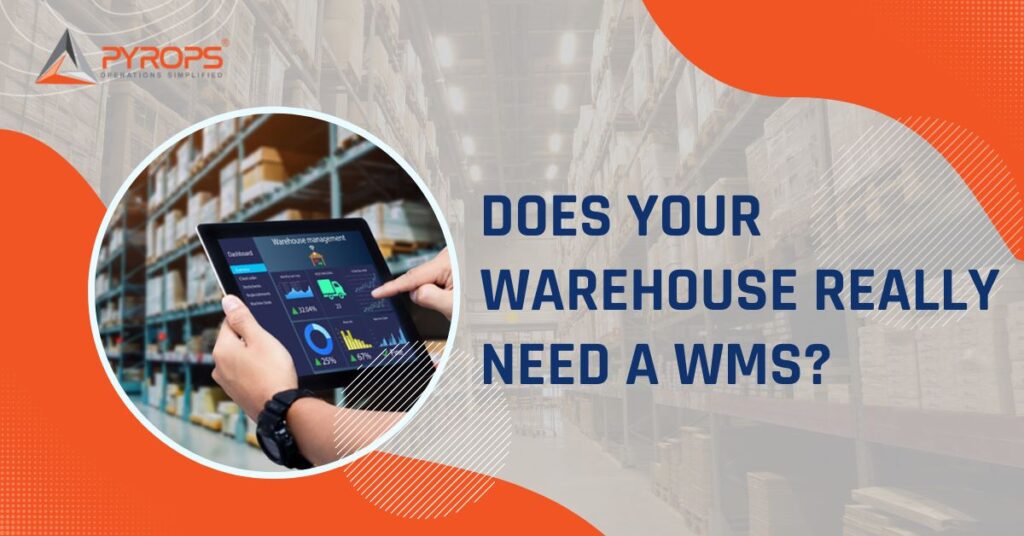
Does your Warehouse really need a WMS?

Warehouse Management Systems (WMS) are crucial for growing businesses with on-hand inventory. While businesses cite the benefits of operational efficiency, accuracy, and centralized control. Many times businesses may not be exploiting the complete capability of a WMS. This brings us to the question – does your warehouse really need WMS software? Warehouse management systems (WMS) can have a direct impact on your ROI by increasing throughput and maintaining efficient processes. WMS system software also helps to ensure that the right products are shipped, the necessary products are stocked, and redundancy and discrepancies are avoided. Warehouse management software provides the tools you need to remain competitive and comply with rules and regulations. Warehouse management systems (WMS) are crucial for growing businesses with on-hand inventory. While businesses cite the benefits of operational efficiency, accuracy, and centralized control, Many times, businesses may not be exploiting the complete capabilities of a WMS. This brings us to the question: does your warehouse really need WMS software? They fill the managerial gaps in integrating all functions in a warehouse operation to boost productivity with the power of warehouse automation and real-time data. Let us evaluate different scenarios in which a company can enjoy the true benefits of WMS software if it invests in the right software. The global warehouse management systems market is expected to grow at a compound annual growth rate (CAGR) of 15.3% from 2021 to 2028. Read report summary by Grand View Research What type of logistic operations can benefit from a WMS  system? WMS logistics and warehouse management systems (WMS) can play a significant role in optimizing picking operations and reducing costs. Picking constitutes a substantial portion of warehouse operation costs and is directly associated with customer satisfaction. In typical warehousing operations, pickers spend 60% of their time walking between locations. Adopting the right picking strategy is key to driving down picking costs by increasing picker productivity and accuracy. As in all areas of operations management, there is often a trade-off between competing objectives—productivity, accuracy, and time required for an activity.  Warehouse management systems (WMS) can help you optimize order picking operations by selecting the right picking method for your specific needs. There are many factors to consider when choosing a picking method, such as the characteristics of the product being handled, the total number of orders, picks per order, quantity per pick, picks per SKU, and the total number of SKUs. Additionally, many businesses need to use a combination of picking methods to handle diverse product and order characteristics. 1. Third-party logistics WMS logistics can help 3PLs manage multi-client warehouses efficiently and effectively. The idea behind a multi-client warehouse is that tenants can share resources, such as labor, material handling equipment, packaging material, and storage space, to avoid a large upfront investment. However, the multi-client structure of a warehouse can make operational efficiency challenging. A logistics warehouse management system can help 3PLs carefully allocate warehouse resources to clients based on logically defined patterns, such as product type, order volume, and delivery deadlines. This can help to improve operational efficiency and ensure that all clients are satisfied with the level of service they receive. A WMS system increases the operational efficiency of all the users in tandem through: Automated allocation of warehouse resources like labor and material handling equipment based on contract terms, changing requirements, and dynamic needs for services like kitting, bulk packaging, cross-docking, etc. A WMS solution is compatible enough for integration with ERP systems of multiple clients. Smart routing is crucial than ever as the operatives might fulfill orders originating from different clients that make coordination difficult. The most basic utility of increased visibility is important because of complex material storage. 2. Multi-location warehouse Multi-location warehouse management systems help spread the inventory, increasing operational and fulfillment capability. The perks of this arrangement include cutting down on shipping time, internal transfers to high-demand warehouses, moving products from overstock warehouses, easy deliveries to remote locations, etc. The complex structure of multi-location warehousing management requires equally efficient supervision of inventory movement and storage. So the WMS solutions come into play as they serve the following requirements: Understand the patterns of different SKU requirements at different locations to maximize the utility of having a multi-location warehouse. Low-stock & out-of-stock alert thresholds for different locations. Precise internal transfers based on requirements of concerned facilities. Real-time data and intuitive dashboard to present an instant view of what’s where. The WMS works as centralized administration to effectively manage the movement of products. 3. Omni-channel retail The best warehouse management systems (WMS) can help companies transform their traditional warehouses into omnichannel fulfillment centers.Omnichannel supply chains face incoming orders from all directions, including stores, marketplaces, internal transfers, and product returns. This requires a thorough analysis of current processes and a detailed transformation roadmap. WMS software can enhance a company’s visibility into various operations and reconfigure them to meet the requirements of an omnichannel warehouse. WMS system software also provides one-touch integration across various sales channels and stakeholders, such as delivery service providers, distributors, and suppliers. Modern WMS solutions are being considered facilitators of Omnichannel presence because of the following reasons. Order status updates. The WMS system software is linked to major online marketplaces. Omni-channel visibility of incoming orders, orders in transit, product returns, and material procurement. Tech-driven data exchange through API integrations. What type of industry can benefit from WMS software? The type of industry and nature of fulfillment determine the supply chain complexity of an organization. Additionally, business dynamics are fast evolving, given the unprecedented situation the world is currently facing. Every industry faces supply chain challenges specific to its operations and processes. An evolved WMS solution helps to tackle such challenges systematically. 1. E-commerce Warehouse management systems (WMS) can help e-commerce businesses overcome the challenges of fulfilling online orders accurately and efficiently.E-commerce businesses typically have a large variety of SKUs with low inventory levels and small order baskets. This requires precise location management and put-and-pick orchestration to ensure efficient order fulfillment. Online sales also generate

Pyrops® WMS is a warehouse management software designed, developed, and implemented by Precision Pyramid Private Limited.

For more info visit: www.precisionpyramid.com

India Head Office

A-1, Forest Lane, Near Ghitorni Metro Station, MG Road, Sultanpur, New Delhi – 110030

Nepal Corporate Office

Precision Pyramid Nepal Private Limited 6th Floor, Radha Bhawan, Tripureshwar, Kathmandu, Nepal

Contacts

Follow us

Scroll to Top